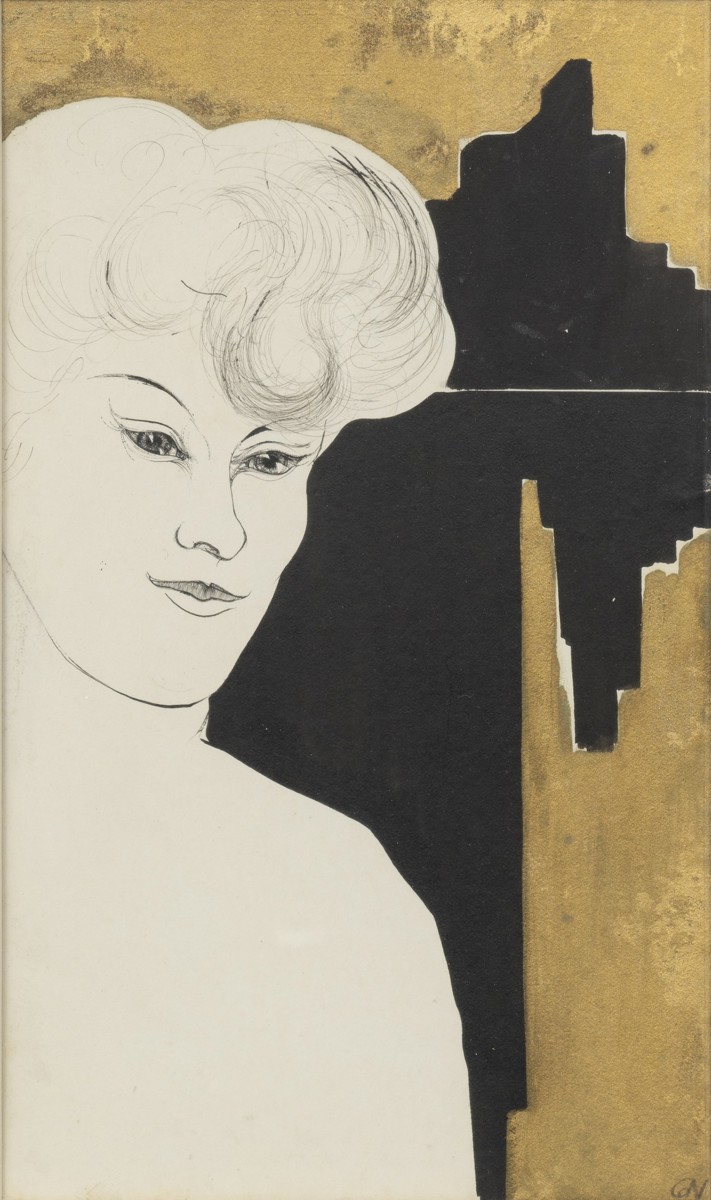
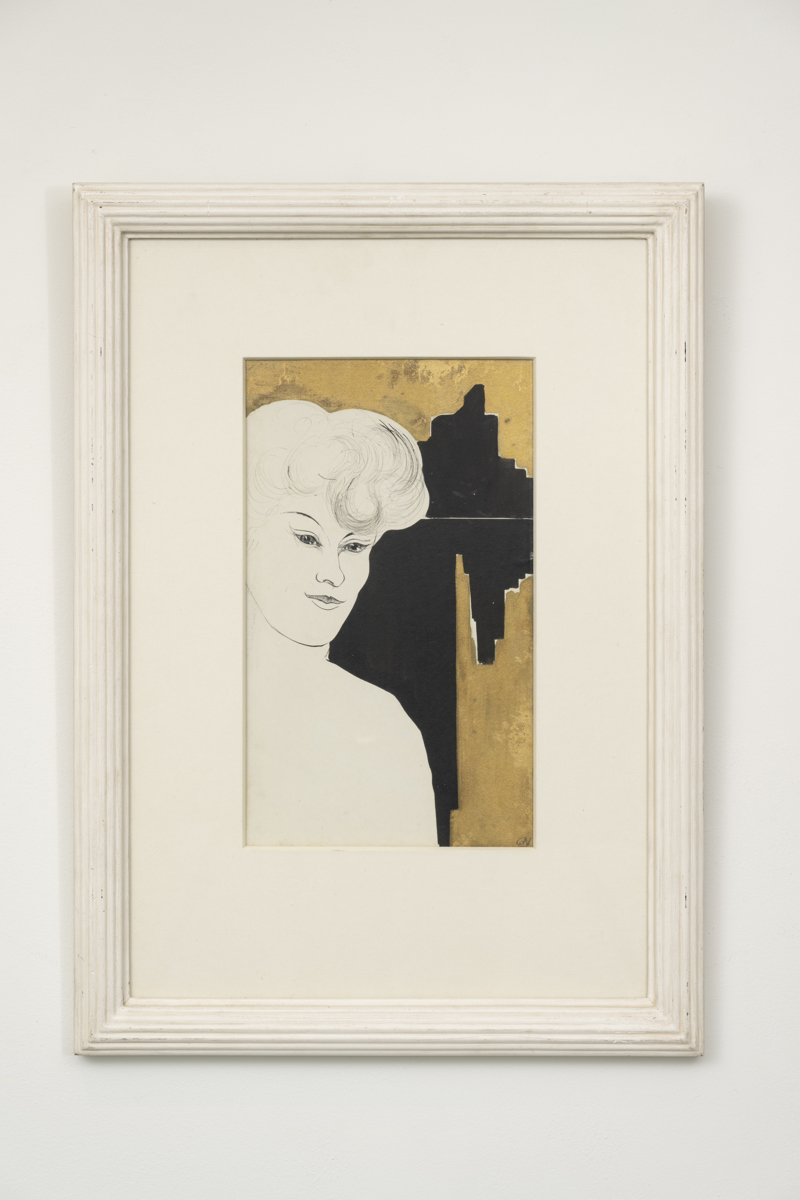
Portrait Idée Mme de S 1904
Carel de Nerée tot Babberich
* 1880 in Zevenaar † 1909 in Todtmoos
Indian ink and wash with gold leaf on board. Size of sheet. 33.5 x 20 cm.
Signed with monogram and dated. ‘CdN ‘04’.
Verso inscribed by artist: ‘Portret Idée Mme de S. no. [erased]/Febr. 1904-Juni 1904’.
Provenance:
d’Audretsch, 1966;
Paul Citroen;
Piccadilly Gallery, London.
Exhibitions:
Groningen 1912 A47;
Scheveningen 1913, Arnhem 1913;
Rotterdam 1914, Utrecht 1914, A54;
London 1966 no. 4, Portrait Study of Mmme de S.;
Munich 1970 no. 4;
Laren 1974-75 no 34;
Kleef 1975 no. 38.
Literature:
Bink & Veeze, Leiden 2025, no. 174.
The real “Madame de S.” was Kasarina de Schestoff, wife of a Russian prince suffering from tuberculosis, also convalescing in Montreux. There, she and Carel de Nerée tot Babberich met and began an affair which also continued in Todtmoos. There is (not unexpectedly), very little documentation of the affair. Only a single letter survives from Madame de S. to de Nerée tot Babberich, expressing fairly perfunctory greetings and sending her unwitting husband’s admiration to the young artist. Clearly, their affair was a secret. This illicit relationship, however, hardly seems to have brought de Nerée tot Babberich much joy. Writing from Montreux, he reports to his mother, Constance: ‘I had a little romance with a lady here, a Russian woman who lives near us, but it made me sad and wistful, mais la saison est morte’. In 1904, de Nerée tot Babberich painted at least 5 portraits of “Madame de S.” as a sophisticated woman of progressive morals. de Nerée tot Babberich’s idealisation of de Schestoff as an untrammelled if irasciable forward-thinker was so radical that a critic in the Algemeen Handelsblad newspaper in 1910 had suggested she was ‘idealised’ his model as a prostitute. This is a reactionary response to de Nerée tot Babberich’s surprisingly unconventional approach to portraying women. The artist does not characterise “Madame de S.” by a demure passivity – instead, she arrestingly meets the viewer’s eye. The bouquet she holds transfigures as a confident assertion of feminine sexuality. Strangely most scandalously, as Passchaert notes in his 1910 catalogue of the artist’s works, de Schestoff is ‘wearing trousers’ – a remarkably unconventional (almost illicit) transgression of gendered binaries for the time.
P.O.R.