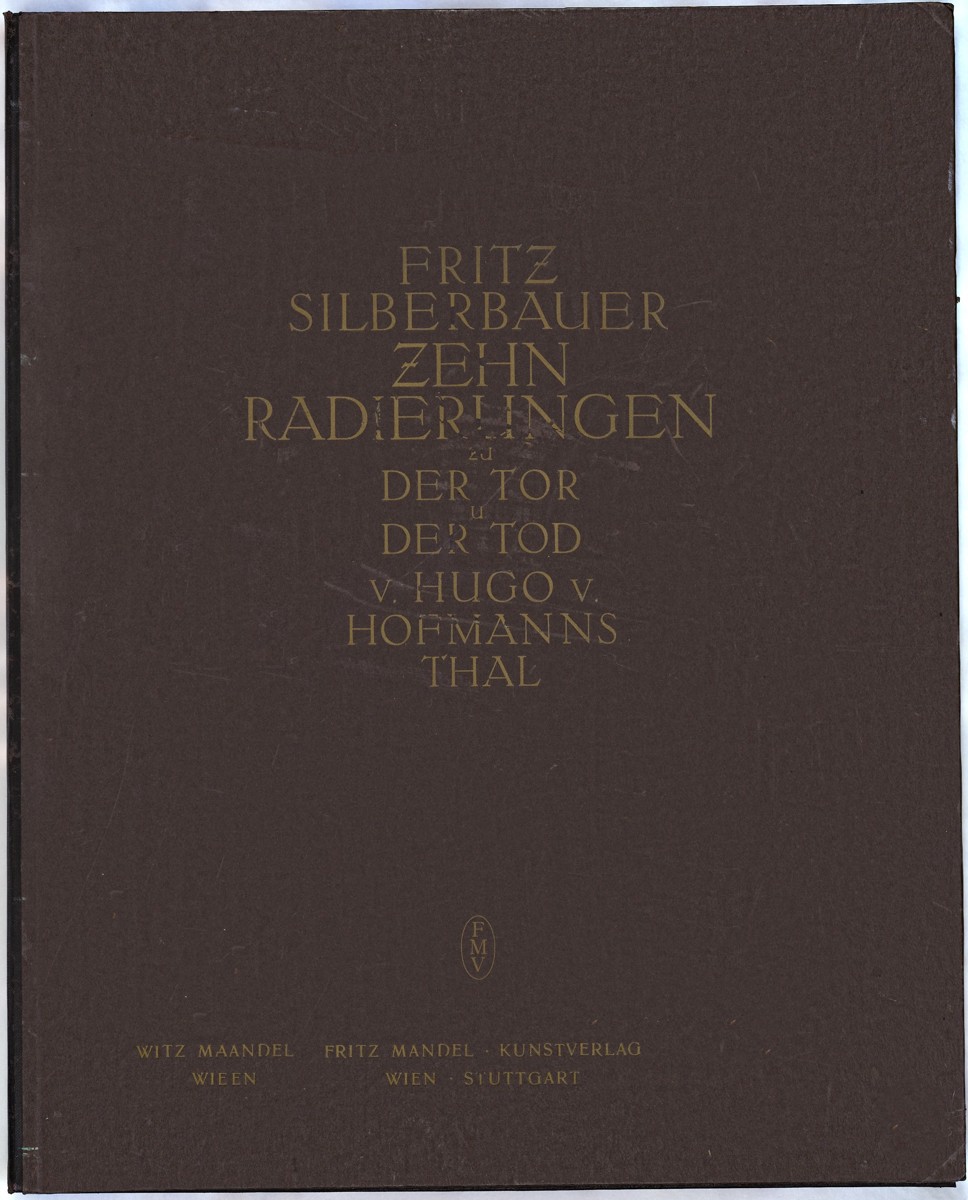
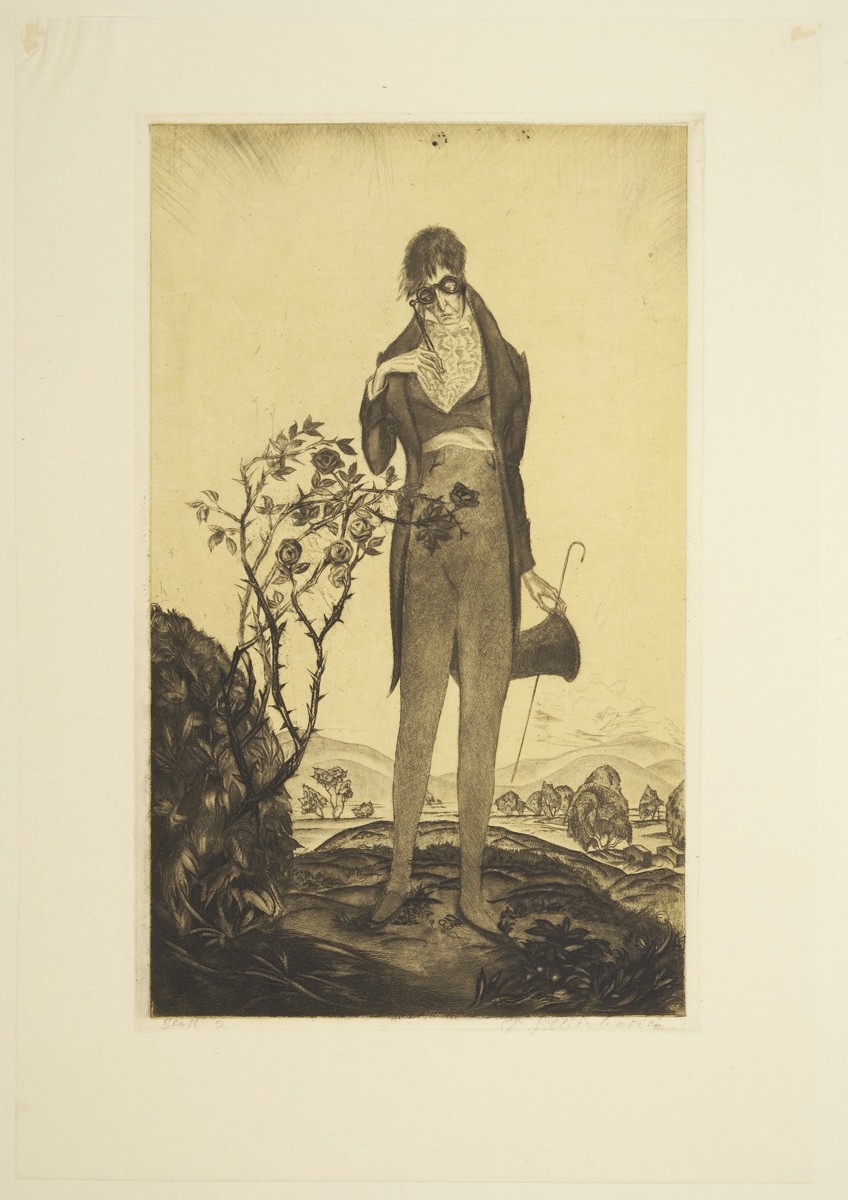
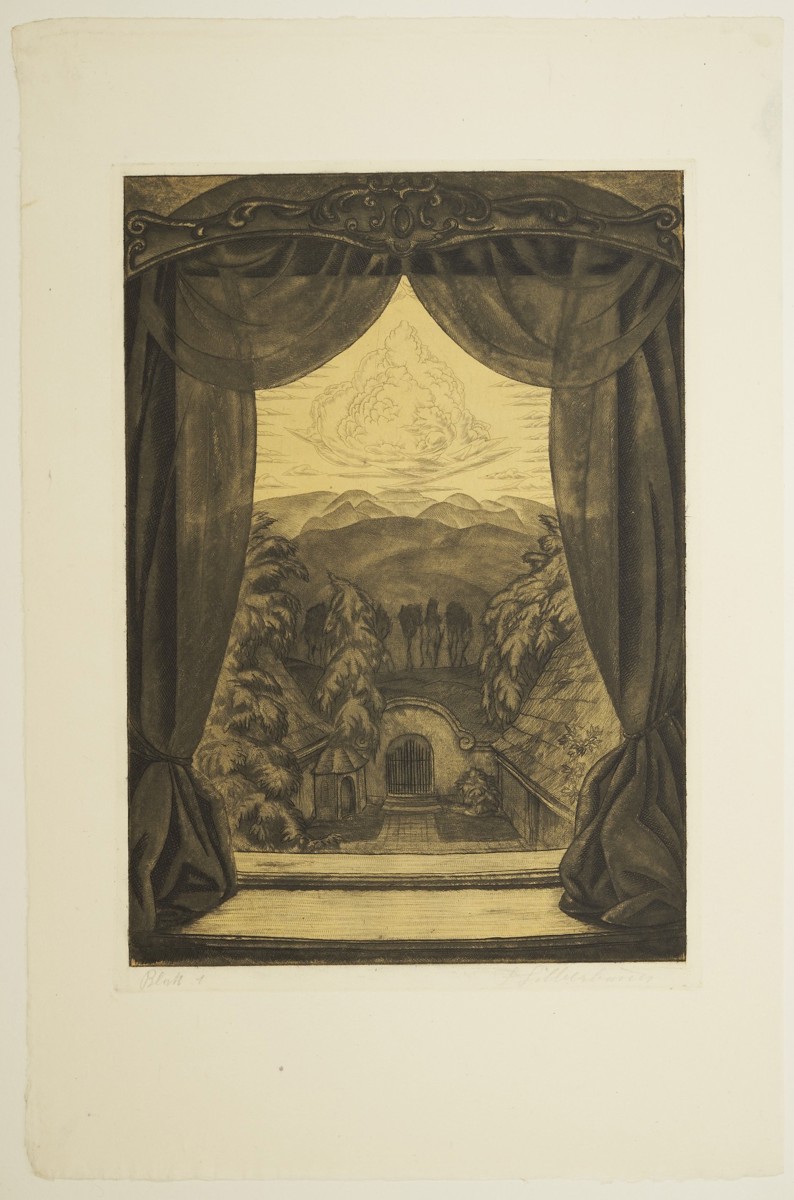
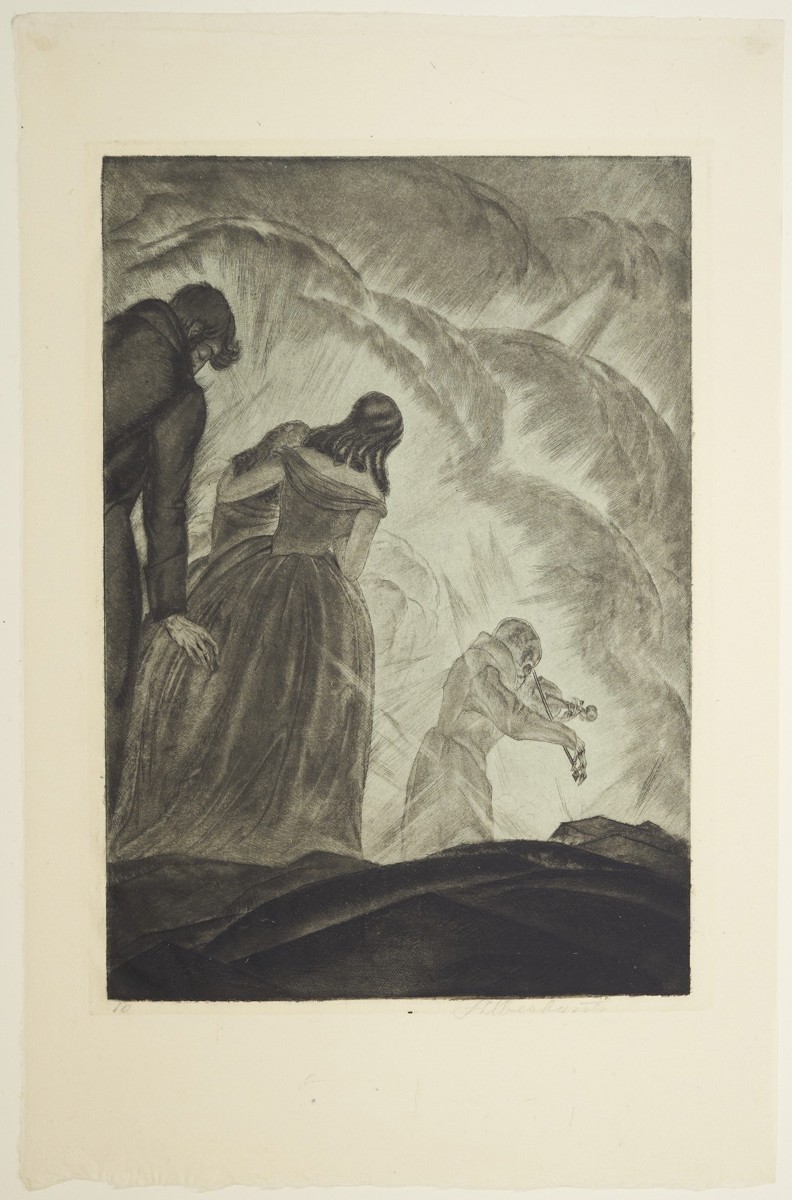
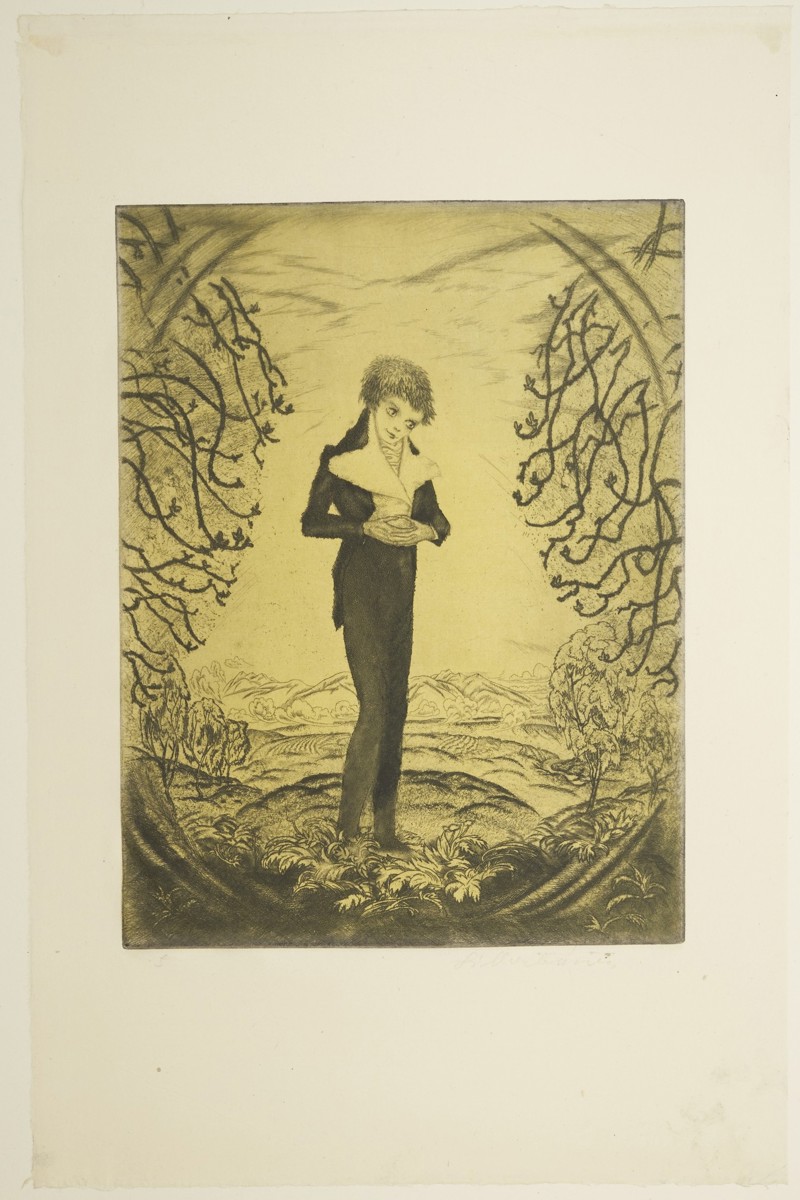
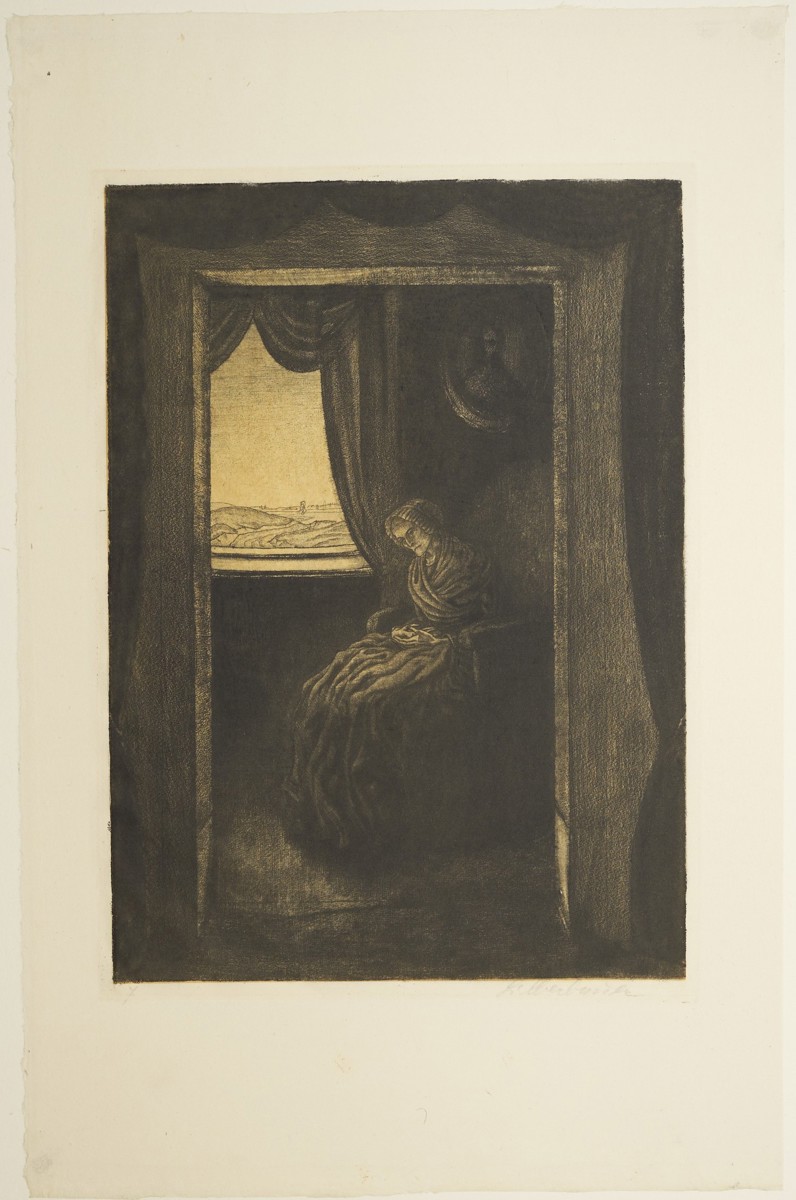
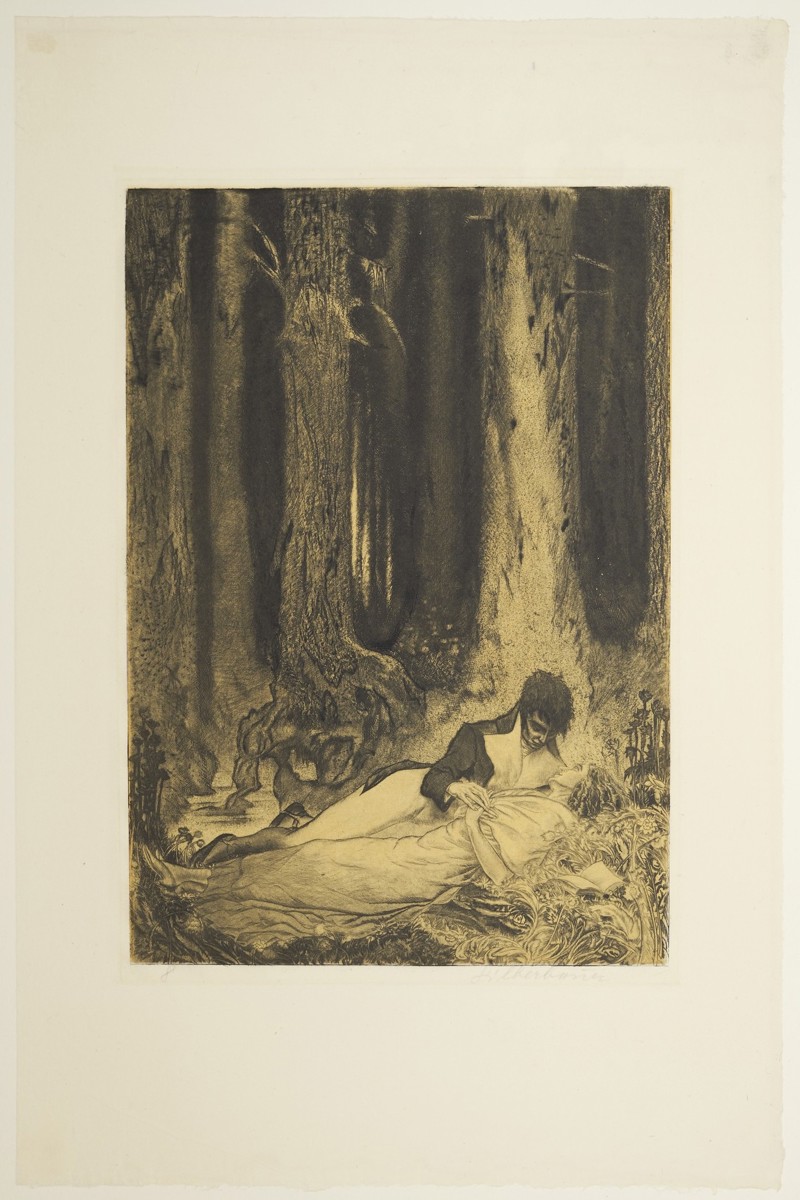
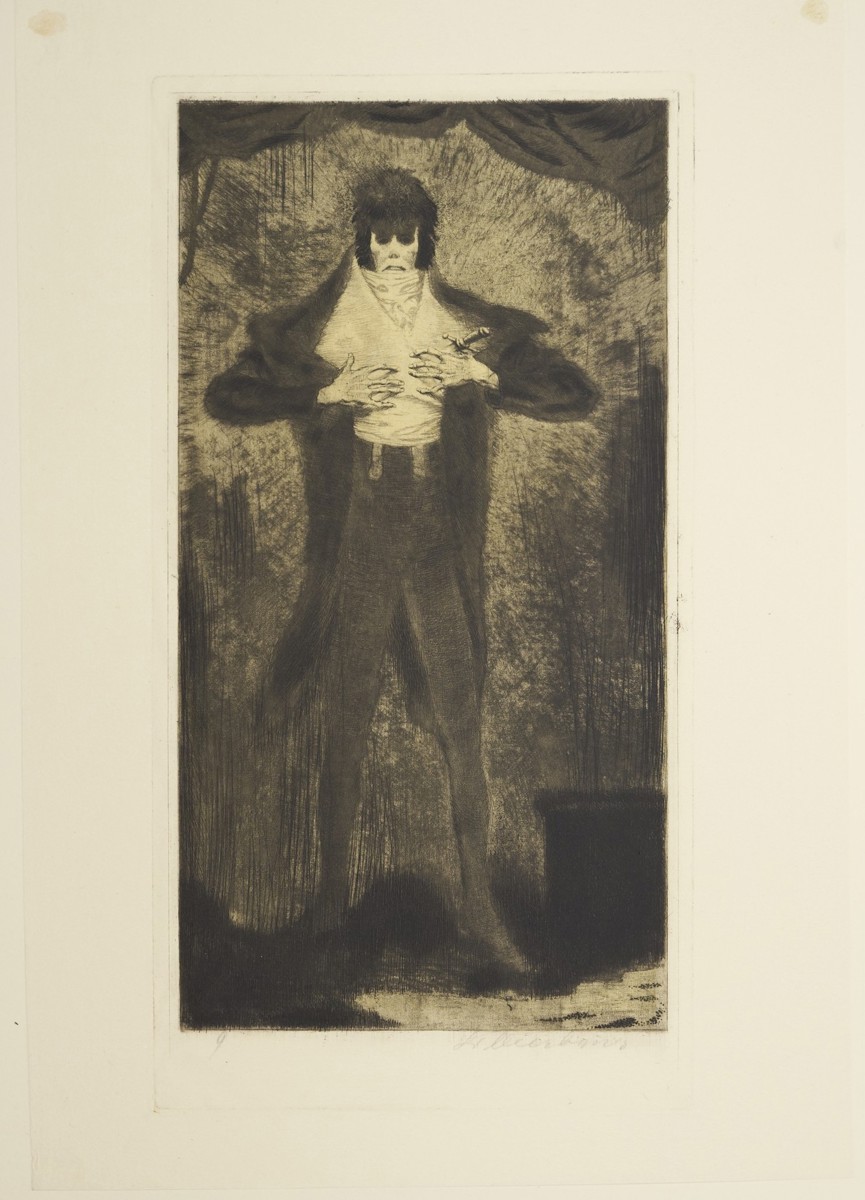
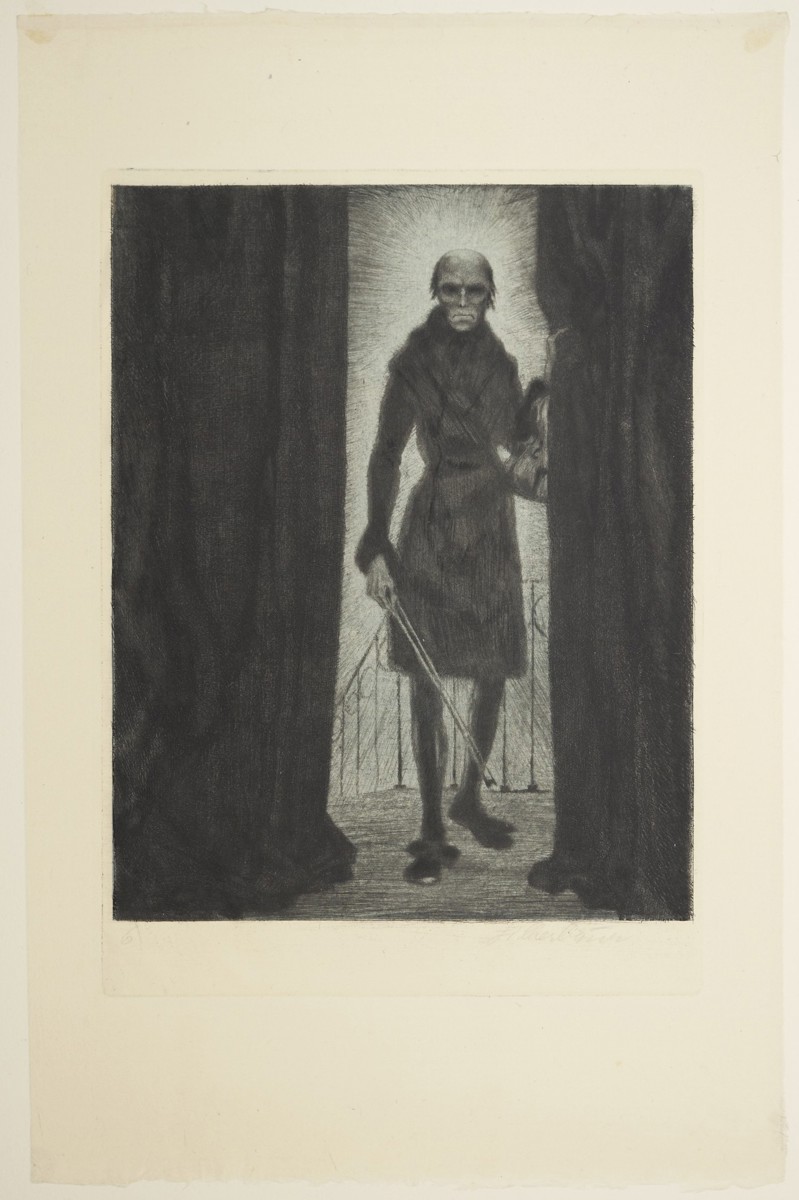
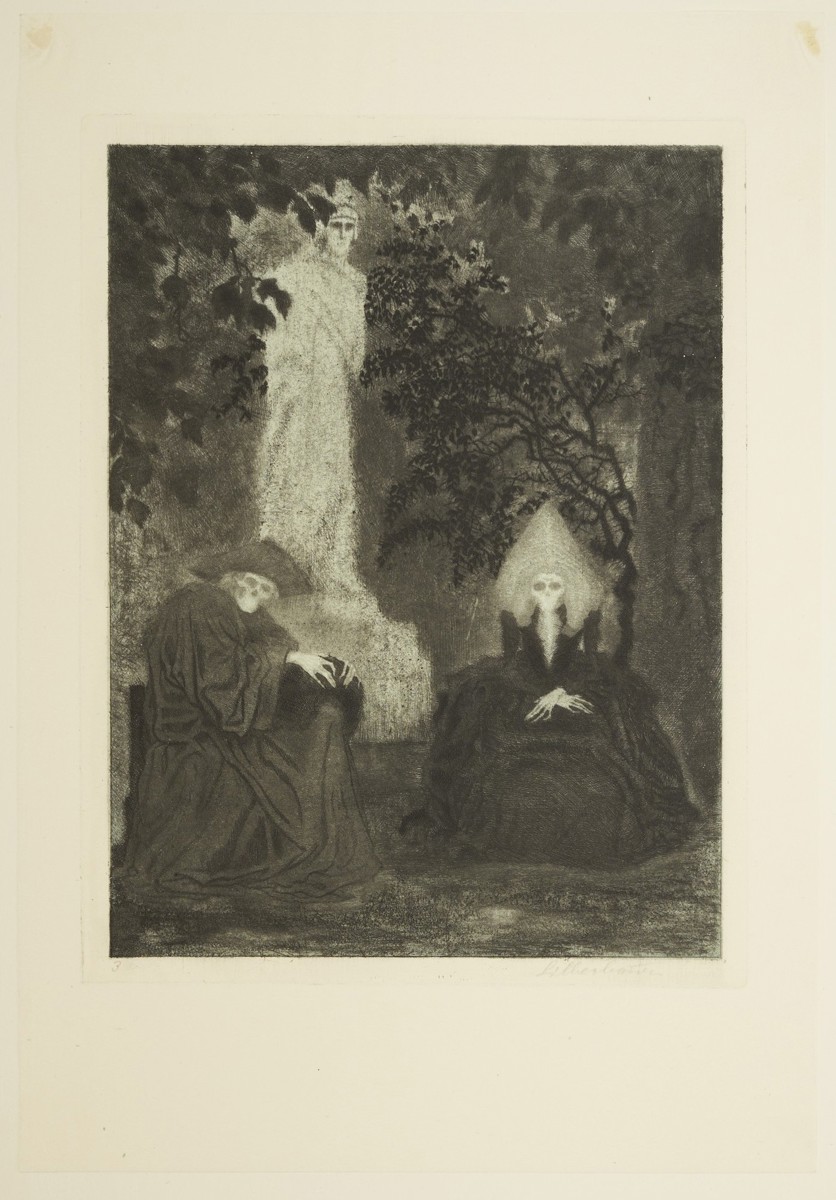
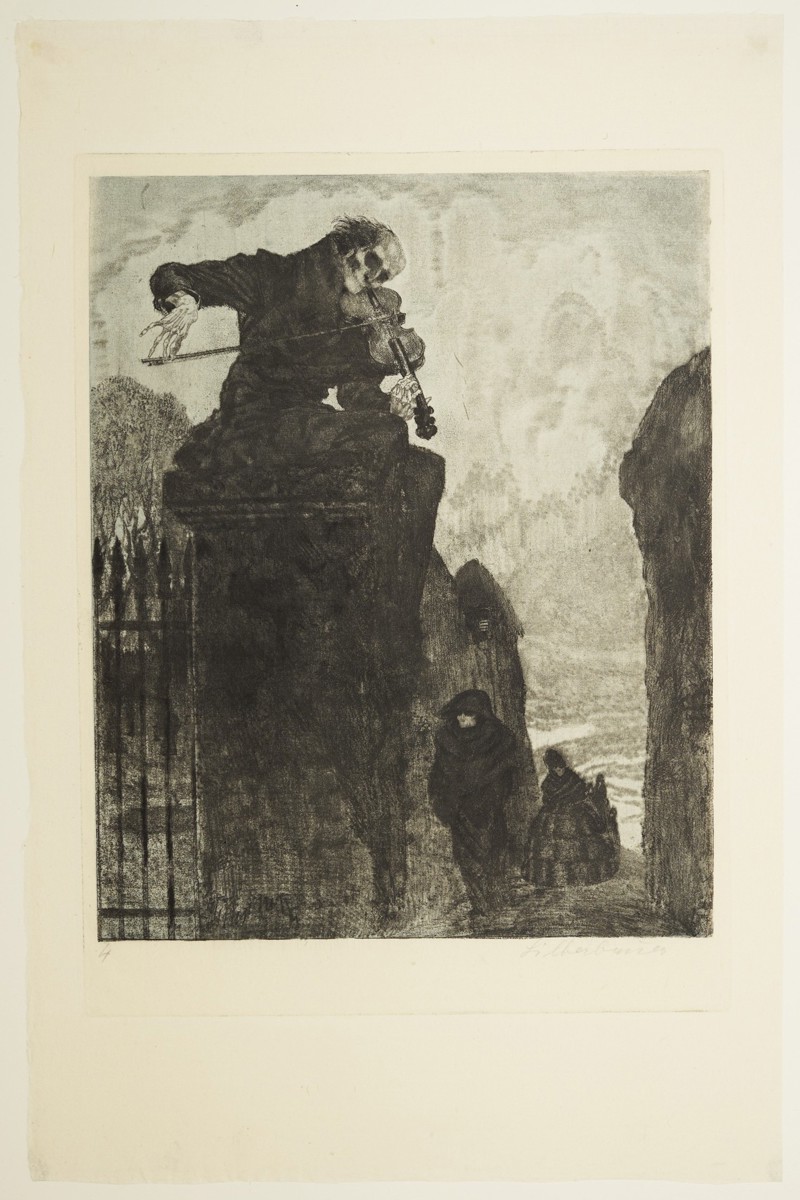
Der Tor und der Tod [Death and the Fool] 1924
Fritz Silberbauer
* 1883 in Leibniz † 1974 in Graz
Colour etchings on japon paper. Different plate sizes. Size of sheet: up to 41.5 x 26.5 cm.
£ 7,500. -
Series of illustrations for the lyrical drama by Hugo von Hofmannsthal, which was first published in 1894, the year after it was written, in the ‘Moderner Musen-Almanach’ (‘the Modern Muses’ Almanac’) under the pseudonym ‘Loris’. Set in the 1820s, the play centres on the nobleman Claudio and his encounter with death. Death approaches Claudio to lead him away from life, confronting him with important figures in his life who have gone before him – his mother, a former lover, and a friend from his youth. In the course of these encounters, it becomes clear that Claudio had never formed meaningful relationships with these people. Like a dandy, he had kept a distant, solely aesthetic stance towards them, never opening himself up to them or letting them close to him. He becomes conscious of this deficit only when he realises that he must die, and paradoxically it is on his deathbed that he is emotionally alive for the first time.72 Rather than propagating it in the way that symbolism might, Hofmannsthal’s lyrical drama is seen as a criticism of Claudio’s aestheticism.73 The set itself was produced in two phases. With the encouragement of his teacher Ferdinand Schmutzer, Silberbauer produced preliminary sketches for the first charcoal drawings in 1913, whilst still studying at the Academy of Fine Arts in Vienna. At this time, Hugo von Hofmannsthal was seen as the leading figure in Viennese Neo-Romanticism, which aligned itself not so much with German Romanticism as with French Symbolism. In 1914, he composed his first four sheets, completing the set in 1921 with a further six. The title page was the last to be finished. This set is now seen as Silberbauer’s major graphic work of art. ‘Such have I lost myself to my art That I see not the sun but through dead eyes And hear nothing but through dead ears’ Silberbauer completed his apprenticeship in Graz in 1902. He received his first real artistic inspiration around 1909 through his nature studies of the landscapes in Bukowina, situated on the border between northern Romania and Ukraine. He later studied at the academies in Dresden and Vienna, where he also subsequently trained as a lithographer. In 1923 he co-founded the Grazer Secession, the oldest artists’ association in Graz. Following the Vienna Secessionists, which included Gustav Klimt, the secession in Graz rejected the popular historicist artists who were reviving the classical artistic styles of the old European Masters. The Secessionists were progressive modernists who broke the conventions laid down by the fine arts intelligentsia, including the Vienna Secessionists themselves, who by this time had come to be seen as the leading establishment.
72 G. von Wilpert. Sachwörterbuch der Literatur (Kröners Taschenausgabe. Band 231). 5. verbesserte und erweiterte Auflage. Kröner, Stuttgart 1969, pp. 755–756. 73 N. Karczewska. ‘Karl Kraus und seine Zeit. Das Wien des Fin de Siècle – Metropole oder kosmopolitische Provinz’. In: Studia Posnaniensia Germanica. Poznań, 2001, p.75.