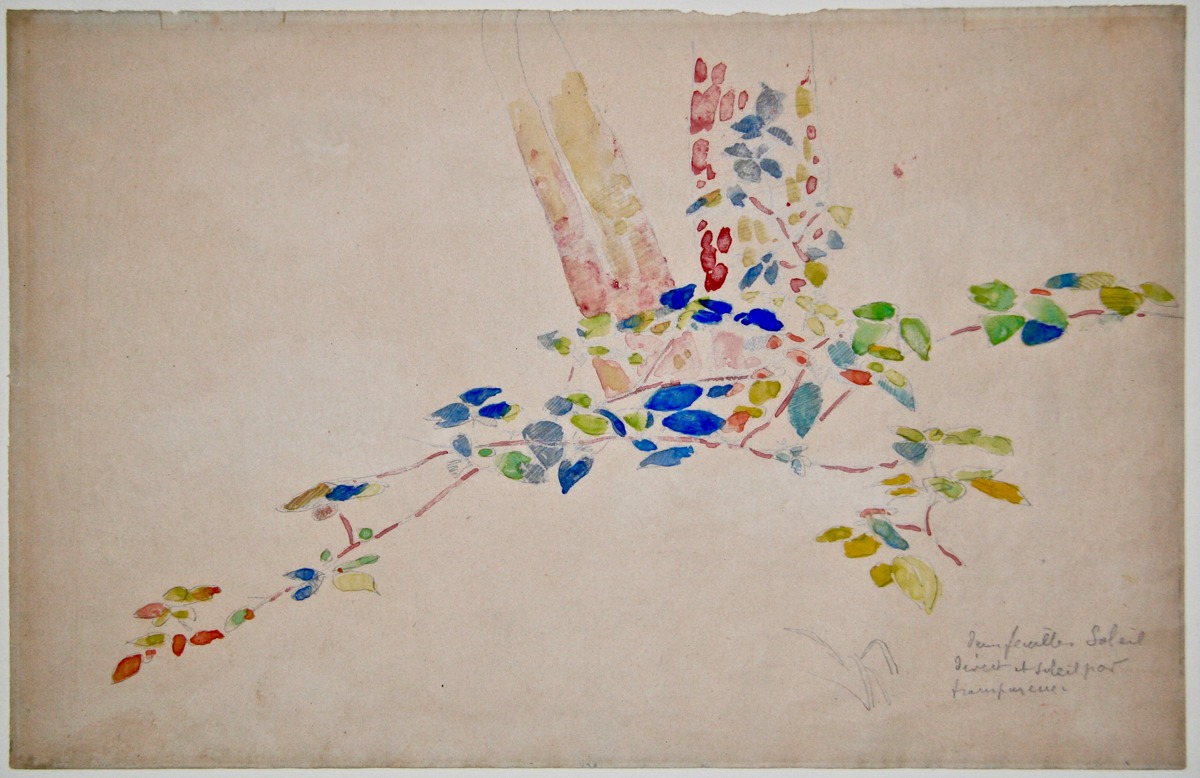
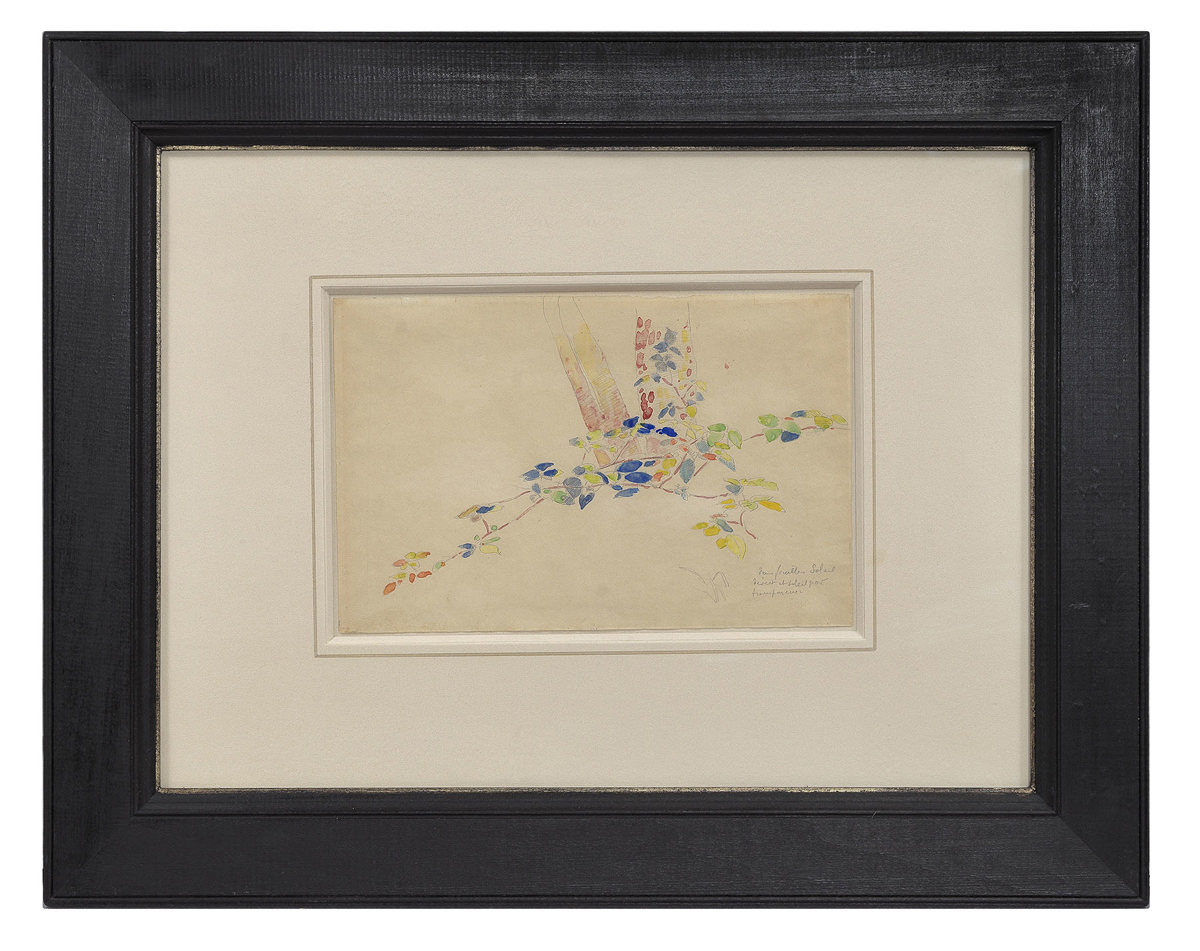
Studies of Branches c. 1890s
Henri-Edmond Cross
* 1856 in Douai † 1910 in Var
Watercolour on simili-japon paper. Size of sheet: 19.8 x 31 cm.
Inscribed by the artist lower left, “deux feuilles Soleil direct et soleil par transference”. Stamped with the artist’s estate stamp.
Provenance: Eric Gustav Carlson (1940-2016).
£ 8,000. -
Henri-Edmond Delacroix started his studies in 1878 at the Écoles Académiques de Dessin et d'Architecture in Lille and moved to Paris, where he continued his studies in Émile Dupont-Zipcy's atelier. That same year, he exhibited at the Salon for the first time. To avoid being mistaken for the romantic painter Eugène Delacroix, he decided to change his name to "Henri Cross" (an anglicisation of his family name). Later, in 1886, he would finally adopt the name "Henri-Edmond Cross" in order to distinguish himself from the French painter Henri Cros (1840-1907). In 1884, Cross co-founded the "Société des Artistes Indépendants", where he met the Neo-Impressionist painters Seurat, Dubois-Pillet, and Angrand. 1891 - the year of Seurat's death - would prove to be a turning point in Cross's artistic career when he took his first step into Neo-Impressionist painting by exhibiting the Divisionist portrait of his wife (now at the Musée d’Orsay). It was also the year in which the artist was to relocate to the South or France on account of his rheumatism. He initially settled in Cabasson, before moving to Saint-Clair, where he would stay for the rest of his life, except his yearly visits to Paris to show his works at the Salon des Indépendants. A year after the artist’s arrival in Saint-Clair, Paul Signac moved to nearby Saint-Tropez. In the company of Signac, Cross acquired a new confidence, painting sea views and scenes from country life which reflected his engagement with anarchist ideology. Cross also struck up close friendships with Angrand, Luce, Van Rysselberghe and Félix Fénéon, with whom he participated in several salons of Libre Esthétique, in Brussels. From the mid 1890s, Signac and Cross abandoned the tiny coloured dots that had characterised their early work, for broad, orderly brushstrokes that recall mosaic tessellations. This style was to define the so-called "second generation Neo-Impressionism", which would play an important role in the shaping of Fauvism. Many Fauvist artists - such as Matisse, Derain, Puy, Manguin, Camoin, Marquet, and Valtat - were to later visit Saint Clair and Saint-Tropez around 1900, finding inspiration in the area that had been home to Signac and Cross.