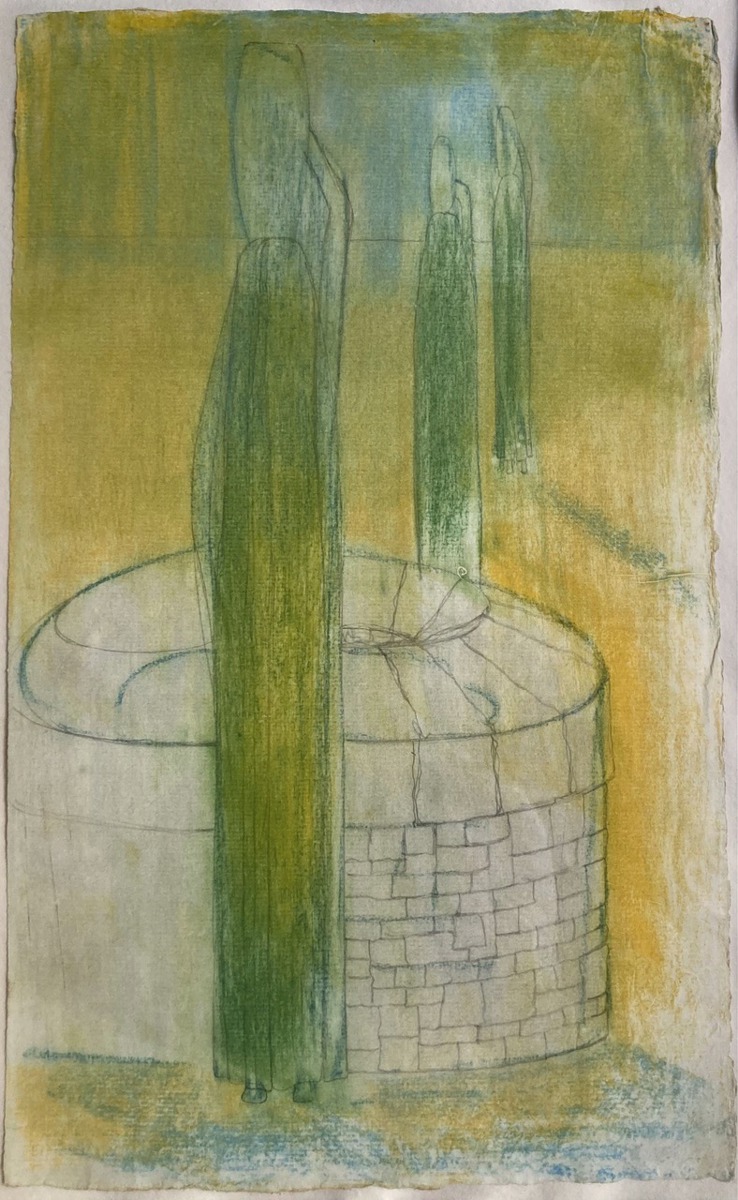
Illustration Maeterlinck c.1898-99
Carel de Nerée tot Babberich
* 1880 in Zevenaar † 1909 in Todtmoos
Chalk and pastel on paper. Size of sheet: 34.5 x 21.5 cm.
Provenance:
Atelier de feu de l’artiste peintre
Christophe Karel Henri de Nerée tot Babberich [part II] Amsterdam, Mak,
21-23 March 1933, no. 67: ‘Quatre dessins au crayons au couleurs, dont deux
sont des illustrations pour un livre de Maeterlinck'. Bought by Van der Linde;
Gallery Liernur, The Hague, 1930s-40s;
Sal Slijper, mid 20th century;
J.P. Smid, Gallery Monet, Amsterdam, 1960s-70s;
Piccadilly Gallery, London.
Exhibitions:
Gallery Liernur, The Hague, Nov -Dec, 1935.
Literature:
Bink & Veeze, Leiden 2025, no. 6.
During this period, at the start of his artistic career, the artist cautiously ventured into pastel techniques. These pastel drawings were inspired by the then highly popular ‘neo-mystical’ work of the Flemish writer Maurice Maeterlinck (1862-1949). Maeterlinck’s plays, poems, and essays convey are characterised by a sense of ‘fin-de-siècle pessimism’, and were taken up as the ‘banner under which a whole European youth […] would choose to sail, in search of […] the mysterious, ultimate reason for things, and at the same time of happiness’. Carel’s “Maeterlinck illustrations” bear recall to the symbolist-mystical landscapes of Charles Filiger (1863-1928). In the figures in this work, one could also see a resemblance to the figures in Edvard Munch’s (1863-1944) from the 1890s. de Nerée tot Babberich may here be depicting the well-known ‘fountain of the blind’ from Maeterlinck’s 1893 play “Pelléas and Mélisande”. This ‘miraculous spring’, which is often associated with Mélisande in visual art, is a central location in the play: where she and Prince Goulaud first meet, and where she loses her wedding ring during her rendezvous with Pelléas.
P.O.R.